I develop web applications with Angular, React, JavaScript, TypeScript, C#, .NET, HTML and CSS, and connect web interfaces to backend services through REST APIs. Based in Almere, Netherlands, I’m looking for frontend and full-stack software development opportunities.
Open to software development opportunitiesAlmere, Netherlands
I’m a software developer focused on frontend development and connecting web interfaces to backend services. My experience includes a short-term legacy system migration project at BlueLemon24, a developer role at DevExperts, and software development internships at Conduction B.V. and Bit Academy. My technical background covers Angular, React, JavaScript, TypeScript, C#, .NET, HTML, CSS, REST APIs and SQL databases. I also founded my own company, Melor-IT.
Featured projects
Selected software projects, the technical decisions behind them and my contribution.
Full-Stack
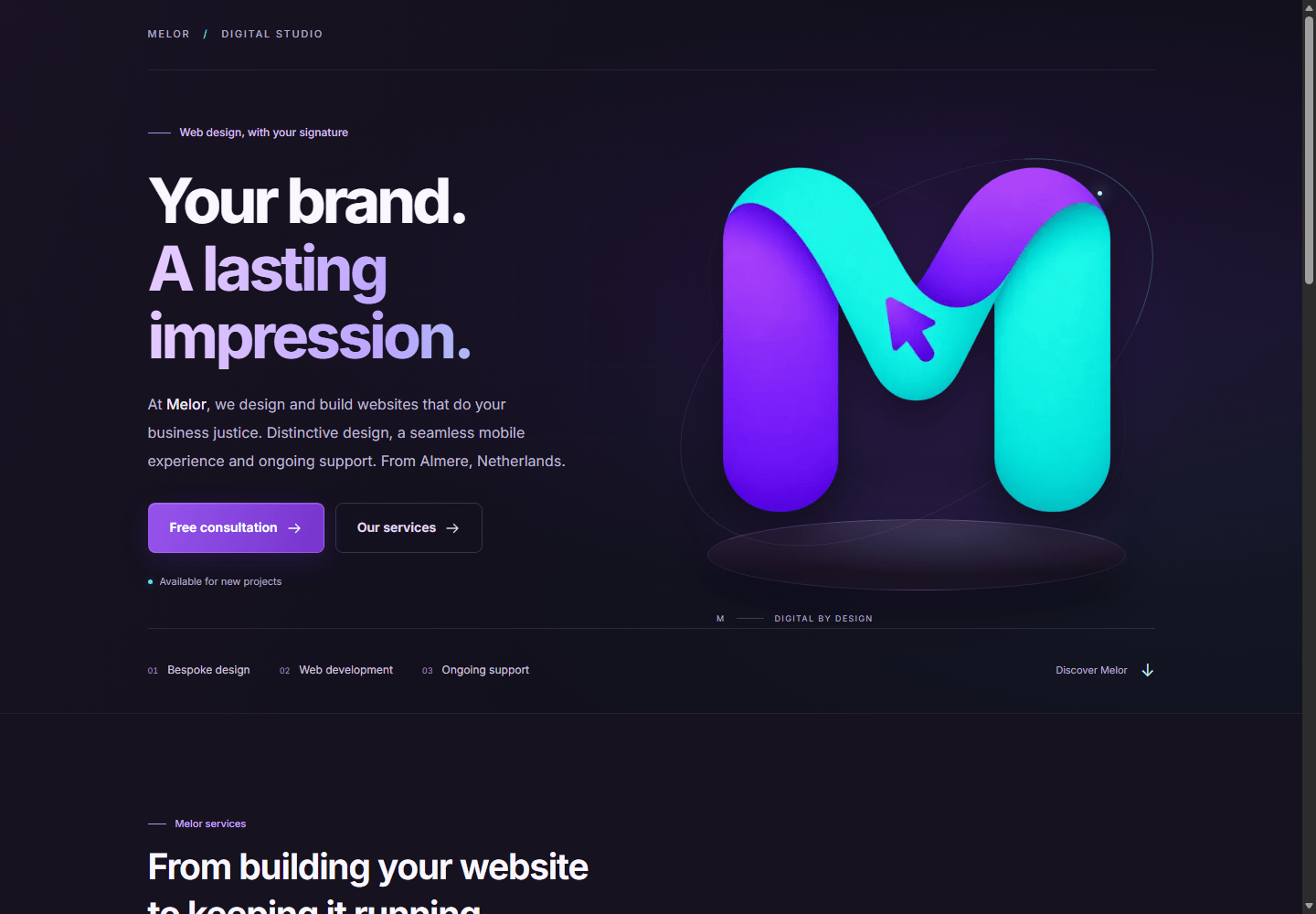
Mel-or — Business Website & Developer Portfolio
A multilingual website combining business service pages with a personal developer portfolio, built with Next.js, React and TypeScript.
Next.js
React
TypeScript
CSS
Google Apps Script
Cloudflare Workers
My role
Developer — frontend and contact API
My contribution
Developed reusable page components, responsive navigation, localized content and a server-side contact endpoint.
Technical challenge
The same site needs Persian RTL and English/Dutch LTR layouts, consistent navigation and contact handling that keeps provider credentials on the server.
Approach
Shared React components use locale-based routes and JSON dictionaries to render content in each language. A Next.js Route Handler validates contact form submissions and forwards them to the email provider.
Result
Business pages and a developer profile are implemented in three languages, with a contact API and profile-specific metadata.
Mel-or presents web services and a personal developer profile within one application. The implementation separates the profile’s identity and navigation while retaining shared layouts and reusable UI components.
Implementation
Built custom React components for the homepage, service details, process steps, developer experience and contact form, styled with responsive CSS.
Implemented Persian, English and Dutch dictionaries, locale-based routing, language switching that preserves the current route, and document-level lang/dir attributes.
Implemented POST /api/contact with server-side validation, request-size and timeout limits, origin checks and rate limiting. The delivery layer supports HMAC-signed Google Apps Script requests and an alternative Resend provider.
Added page-specific canonical URLs, language alternates, Open Graph metadata, structured data, robots.txt and a multilingual sitemap.
Used Next.js image sizing, local font files, static page generation, semantic sections, labelled form fields, keyboard controls and reduced-motion support.
Architectural decisions
Keep localized copy in JSON dictionaries and layout direction in shared components to avoid maintaining three separate page implementations.
Use Server Components for page content and Client Components for interactive controls such as navigation, language switching and contact-form state.
Keep email-provider credentials in server runtime configuration; return controlled delivery states instead of exposing provider responses to the browser.
Maintain an OpenNext/Cloudflare Workers build configuration and automated checks for translations, routing, metadata and contact handling.
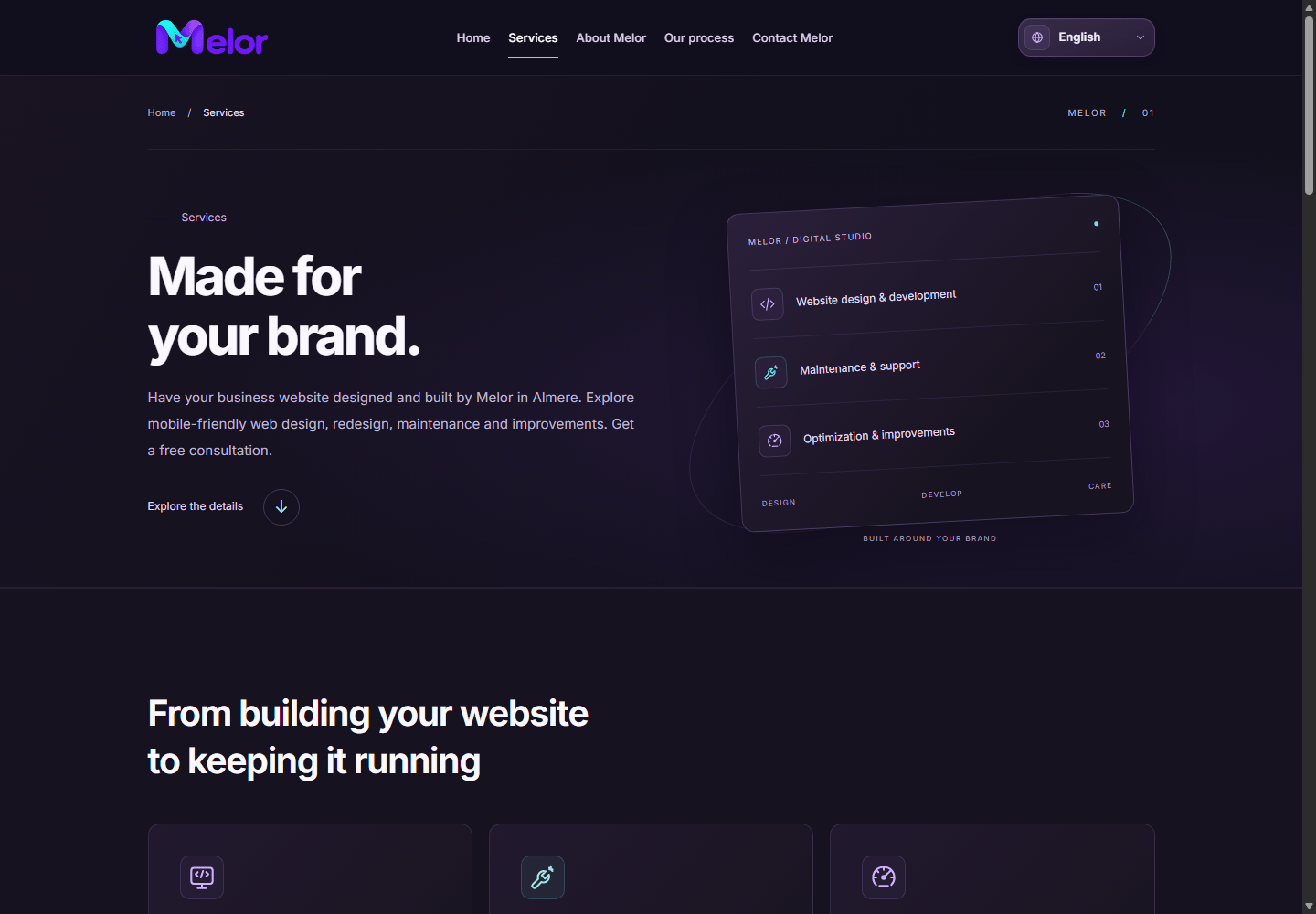
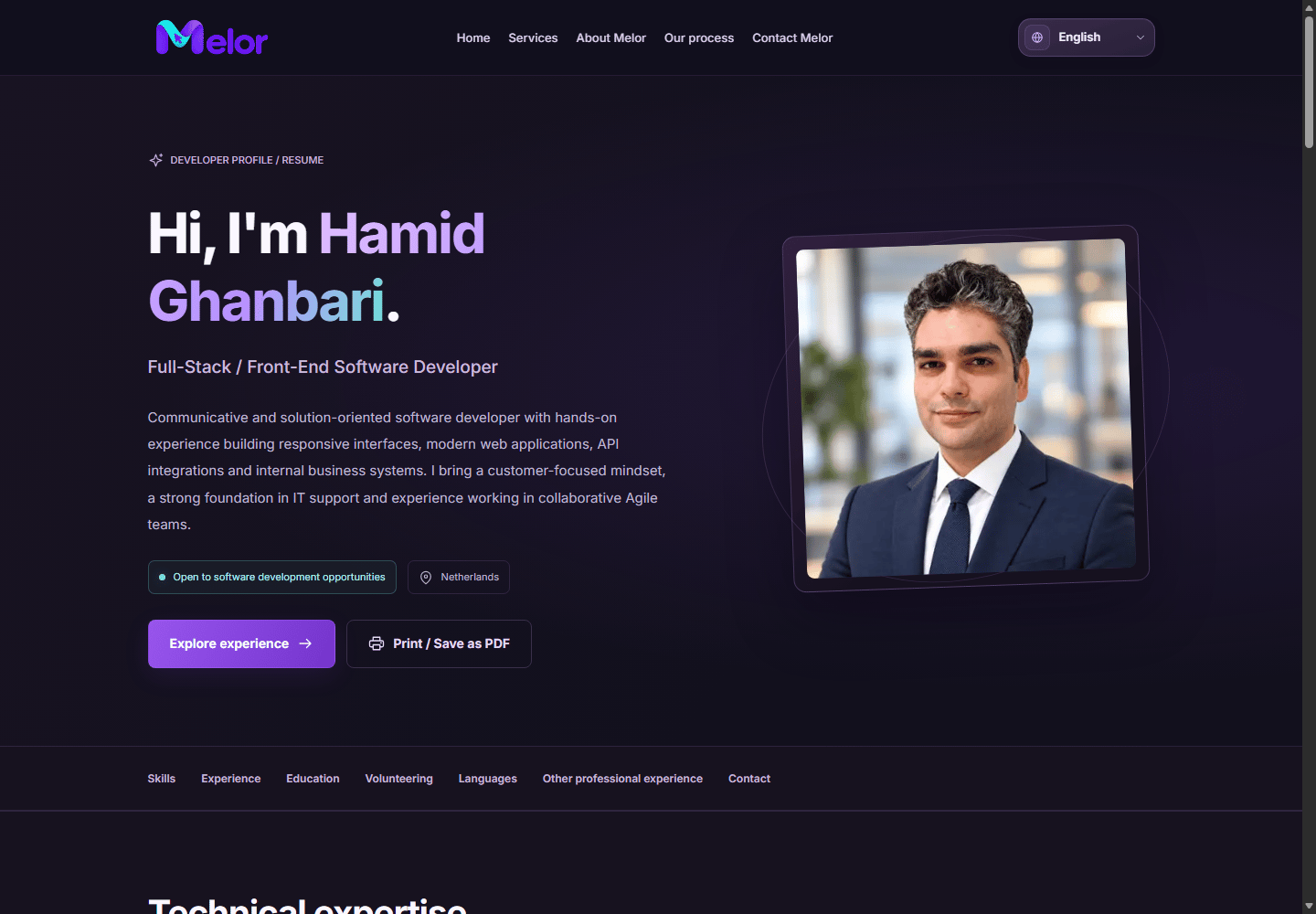
Public website screenshots
Mel-or services page captured from the public English websiteDeveloper profile captured from the public English Mel-or website
Are you hiring a frontend developer, React developer, software developer or full-stack .NET developer in the Netherlands? Get in touch to discuss the role and my experience.